Is LASIK 100% Successful? Success Rate Explained
LASIK has become one of the most talked-about vision correction procedures, and for good reason. People want freedom from glasses, but they also want certainty. So the question comes up again and again: Is LASIK 100% successful?
The honest answer is no surgery in medicine is ever 100%. But the LASIK surgery success rate is very high when the right patient is selected, and the procedure is performed correctly. What matters more than the number itself is understanding what “success” really means in LASIK.
What Does Success Mean in LASIK?
Many people assume success means “perfect vision without any glasses for life.” In medical terms, success is defined slightly differently.
A successful LASIK outcome usually means:
- A spectacle free life for patient
- Clear functional vision for daily activities
- Stable results over time
- No major complications
This is why the LASIK eye surgery success rate India is often reported as very high, but expectations must still be realistic.
What is the Actual LASIK Surgery Success Rate?
Globally, studies show that the LASIK surgery success rate is above 95% for suitable candidates. Most patients achieve vision close to or equal to 6/6, especially for distance vision.
However, a small percentage of patients may:
- Have minor residual power
- Need glasses for certain activities
- Require enhancement procedures
This is where understanding the LASIK failure rate becomes important. Failure does not usually mean loss of vision, but rather outcomes that are slightly below expectations.
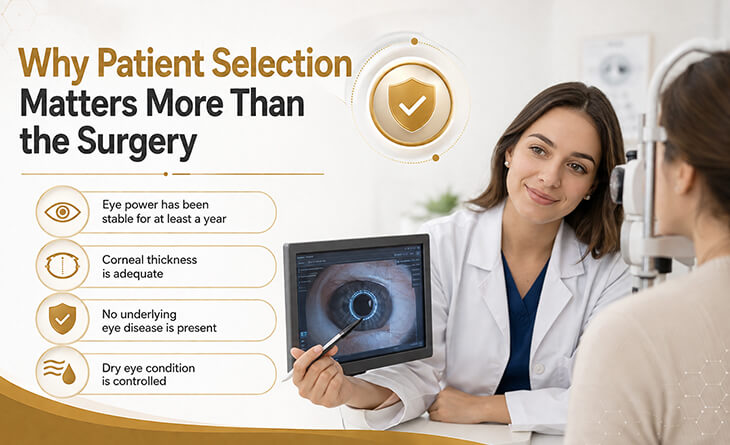
Why Patient Selection Matters More Than the Surgery?
From a clinical perspective, the biggest factor influencing the LASIK complications rate is not the laser machine. It is patient selection.
LASIK works best when:
- Eye power has been stable for at least a year
- Corneal thickness is adequate
- No underlying eye disease is present
- Dry eye condition is controlled
Many complications arise when surgery is done on unsuitable candidates. This is why a detailed evaluation by an experienced eye doctor in Delhi is critical before deciding on LASIK.
Is LASIK Safe Long Term?
One of the most common concerns patients have is: Is LASIK safe long term?
The corneal reshaping done during LASIK is permanent. The structure does not reverse over time. However, the eye itself continues to age.
Long-term changes may include:
- Presbyopia after age 40
- Dryness related to lifestyle or environment
- Cataract development later in life
These are natural changes and not caused by LASIK. This is why understanding does LASIK last permanently requires separating surgical results from ageing changes.
Understanding Risks Without Fear
Every medical procedure has some level of risk, and LASIK is no exception. However, serious complications are uncommon when surgery is performed under proper conditions.
Possible side effects include:
- Temporary dry eyes
- Night glare or halos in early months
- Mild fluctuation in vision during healing
The LASIK complications rate is low, and most issues are temporary and manageable. With proper follow-up, long-term problems are rare.
Why Some Patients Need Enhancement?
In a small number of cases, vision may not reach the desired level after the first procedure. This does not mean the surgery has failed.
Enhancement may be considered when:
- Residual refractive error remains
- Vision affects daily comfort
- Corneal health allows safe retreatment
Understanding this helps put the LASIK failure rate into perspective. Most “failures” are minor adjustments rather than major problems.
How to Improve Your Chances of Success
A high LASIK surgery success rate is not just about technology. It is about preparation, planning, and follow-up.
To improve outcomes:
- Choose a qualified and experienced surgeon
- Be honest about your medical history
- Follow pre- and post-surgery instructions carefully
- Attend all follow-up appointments
These steps significantly improve both safety and satisfaction.
The Reality About LASIK Success Rates Patients Should Know
LASIK is not magic, but it is one of the most predictable and well-studied procedures in ophthalmology. When done for the right reasons and on the right patient, it offers excellent long-term results.
The question is not whether LASIK is 100% successful. The better question is whether it is the right solution for your eyes.
See Clearly, Decide Confidently
Choosing LASIK is a personal decision that should be based on proper evaluation, not assumptions. If you are considering vision correction or want to understand your suitability, a detailed consultation makes all the difference. Dr Anisha Gupta, an experienced eye doctor in Delhi, provides thorough pre-LASIK assessments and personalised guidance to help you understand the true LASIK surgery success rate for your specific case. Schedule a consultation to make an informed and confident decision about your vision.
FAQs About LASIK Success Rate
No. While the LASIK surgery success rate is very high, results vary depending on individual eye conditions and suitability.
The LASIK failure rate is very low. Most cases involve minor residual power rather than serious complications.
Yes. LASIK is considered safe long term, but natural ageing changes in the eye can still affect vision.
The corneal correction remains stable, but age-related vision changes may occur later.
Patient selection, corneal health, and surgeon expertise play a major role in determining outcomes.
Most LASIK-related issues, such as dryness or minor vision changes, are manageable with proper care.
A detailed evaluation by an experienced eye doctor in Delhi is the best way to determine suitability.